I think my view of the cloud is quiet different from people around me. They think that cloud is an oportunity to make better infrastructure. I don’t, I see the cloud as the operating system that will run services and applications for me.
ARGLabs projects list
Here is a list of project repositories of use cases we developed.
Read more: ARGLabs projects listIn order:
Organization administrators scope:
- Pre-requisites for IaC to work and basic Organization stuff
- Post: Main account preparation
- Repository of pre-reqs: https://bitbucket.org/arglabs/arglabs-main-org-prereqs/src/master/
- Basic Org stuff: https://bitbucket.org/arglabs/arglabs-main-org-stuff/src/master/
- Network CIDR control
- AWS Account creation for AIO scope
- Post:
- Repository: https://bitbucket.org/arglabs/arglabs-main-bigbang-aio/src/master/
- Network Infrastructure creation for SRE Team on AIO account
AIO Scope – SRE Team
ARGLabs tech stuff summary
This is for quick reference about our design decisions.
Where terraform data is stored for the company, teams, how DNS works etc.
Everything here is covered by complete articles explaining why.
This is just a quick reference summary.
Read more: ARGLabs tech stuff summaryEnvironments
Environments used in ARGLabs:
- Default: where IaC is developed and every unique stuff is deployed.
- Prd: production environment derived from the default environment.
Scopes
We’ll have just one scope named AIO (for All In One).
AWS Accounts
Read about here: AWS multi-account model and ARGLabs
One account for each environment per scope.
This means:
- AIO Default
- AIO Prd
Network
Each environment will use only one VPC in which each team will have it’s own network.
- Default: 10.255.0.0/16
- SRE Team: 10.255.0.0/24
- Team01: 10.255.1.0/24
- Team02: 10.255.2.0/24
- Prd: 10.0.0.0/16
- SRE Team: 10.0.0.0/24
- Team01: 10.0.1.0/24
- Team02: 10.0.2.0/24
CIDR Control is done at this repo: https://bitbucket.org/arglabs/arglabs-main-org-cidr-control/src/master/
Terraform
Remote state bucket
- arglabs-terraform-states: company-wide stuff. Used for resources outside the teams accounts.
- arglabs-aio-terraform-states: Used to store all AIO account terraform projects.
Terraform and providers versions
We decided to use latest versions because
DNS
Projects
AIO BigBang
AIO Account
SRE Infrastructure
Pending
- AIO bigbang wont have state aggregator anymore and will only save state on the main account s3 bucket.
- Infrastructure repos should get remote state from the main account but stores its states on the bucket inside the default account.
- change-data should help to do this
AWS multi-account model and ARGLabs
An AWS account does not have any cost by itself, so why we should share the same account across different scopes ?
Here we’ll talk about how we think real environments should look like and how we’ll do it in ARGLabs, since it’s just a lab and not a real environment.
Read more: AWS multi-account model and ARGLabsAWS recommends the multi-account model for many reasons, we’ll focus on just a few of them here.
Access control
An AWS account is the first access control layer and blast radius limiting mechanism.
AWS accounts costs nothing by themselves, so you may have 3 or 56 accounts that you will only pay for what you run inside them.
It is much easier to control which accounts users have access to than to control the different access that different users need to different resources within a unique account.
So, access control is the first reason to do that.
Cost
Not only AWS accounts add no cost to your organization but it, in fact, helps to reduce costs.
In a shared account with multiple teams, applications and/or products, how do you know what are the costs for each of them ? Ok you can use tags, but there are many things that are not easy like this.
When you define a scope for AWS accounts and limit it’s usage to that scope, you can easily know the costs of that scope. Say you define a large product as an scope, and you run the entire product on one account and use another one for development/QA environments. The total cost of this product is the simple sum of the 2 accounts billings.
Isolation
Having just one scope inside an AWS account brings ownership to the people involved.
The responsible people is more likely to care about costs, efficiency, security etc because they will be the ones that the finops, security and other teams will talk to in case of problems. They own their product and the AWS account is like their exclusive environment where their product runs on.
The fact that only they are using the AWS account will make them confidently to take decisions like completely purge the development environment when they are not using, reducing costs to literally zero (yes, destroying all the infrastructure also!).
AWS account scope
What is the AWS account for ?
Should we have one set of accounts (environment accounts) by team ? Or by product ?
There’s no one-size-fits-all answer.
You should decide it based on the above benefits. If you have a large product made by a few teams applications and makes sense to have this product costs clearly visible and you don’t need to have different permissions for the teams that will have access to it, go for it.
If you have many apps from a group of teams that are part of a “business unit”, use accounts for that business unit.
You decide it.
In ARGLabs
Here in ARGLabs we’ll be using just one scope for our examples because it’s a lab.
One scope for all, that’s why we named it “The AIO (all-in-one) Scope”, and we’ll have 3 accounts for the different environments.
ECS or EKS: Native cloud containers or kubernetes ?
There’s a lot of articles comparing the two and telling you about their differences and when you should go with one or another. I’ll make it slightly different.
I’ll tell you what I want to accomplish considering technology, culture, operations, costs, support and compliance and what is my choice to do so.
I want to provide developer teams a platform so they can easily build, deploy and run their apps in compliance with the Cloud Engineering Team’s best practices and Security Team’s policies.
Speedup cloud usage, cloud services details abstraction, best practices and security policies enforced, costs and permissions controlled with no bureaucracy and 100% cloud provider support.
CIDR Control with terraform
Do you want to do everything as code ?
Do you know that you CAN manage your CIDRs allocations as code, and that it’s very simple, much more than you probably think ?
Read more: CIDR Control with terraformI’m not telling you that everybody should do it, but here I’ll try to show you that’s possible and very simple.
What are the main benefits ?
- You’ll have a central place to manage every VPC network address
- Everyone could query this central place to discover another team network address
We just need a centralized terraform state that everyone could read.
This terraform project just outputs our CIDRs allocations onto a state every other project can read: https://bitbucket.org/arglabs/arglabs-main-org-cidr-control/src/master/
Just put the CIDRs by environment on the cidr local map variable as following:
# CIDRs delegations:
  cidr = {

    # Entire company cidr by env:
    org = {
      dev = "10.200.0.0/16"
      stg = "10.100.0.0/16"
      prd = "10.0.0.0/16"
      default = ""
    }

    # Teams cidrs:
    sre = {
      dev = "10.200.0.0/24"
      stg = "10.100.0.0/24"
      prd = "10.0.0.0/24"
      default = ""
    }

    team01 = {
      dev = "10.200.1.0/24"
      stg = "10.100.1.0/24"
      prd = "10.0.1.0/24"
      default = ""
    }
    # And so on...

  }
And let the pipeline run:

Then, in every project you need to get your own CIDR or any other CIDR, you can just read the terraform state as following:
data "terraform_remote_state" "cidr" {
  backend   = "s3"
  workspace = "default"
  #workspace = local.env
  config = {
    bucket   = "arglabs-terraform-states"
    region   = "us-east-1"
    role_arn = "arn:aws:iam::005801295308:role/deployer"
    key      = "main/org-cidr-control.tfstate"
  }
}

locals {

  cidr     = data.terraform_remote_state.cidr.outputs.cidr
  org_cidr = data.terraform_remote_state.cidr.outputs.cidr["org"][local.env]
  my_cidr  = data.terraform_remote_state.cidr.outputs.cidr[local.infra_scope_parsed][local.env]
}

output "my_cidr" { value = local.my_cidr }
Main account preparation
First things first. Before we can create resources as code through a pipeline, we need to create some resources to make it possible, specially because we don’t want to use any credentials variables on the pipeline tool.
Read more: Main account preparationMost companies already have all the needed resources to run a terraform project through a pipeline but, as we want to make everything repeatable, we’ve manually created just the very basic resources and made a repository with the “not so basic” resources.
So, what we need to be able to run the “not so basic” terraform project:
- IAM user with access key and secret key
- IAM Identity Center (formerly AWS SSO) enabled
IAM User
Our IAM user will be “iac-main-iam” and will have the following policies:
- AmazonS3FullAccess
- AWSSSOMasterAccountAdministrator
- IAMFullAccess
- STS:AssumeRole
Don’t forget to create access and secret keys.
IAM Identity Center
Go to your main region and enable it.
Terraform pre-reqs project
Get the code here: https://bitbucket.org/arglabs/arglabs-main-org-prereqs/src/master/
Change variables on variables.tf file and remove the state file.
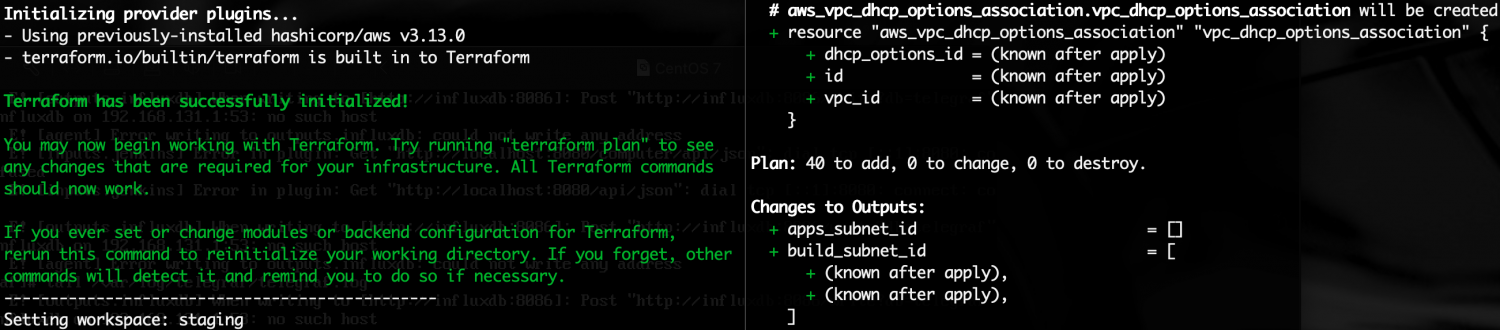
Run it, like in this video:
That’s it.
Terraform Org Stuff project
With these basic resources created, we can now run the next terraform project, now using the pipeline tool.
ARGLabs Org Stuff project: https://bitbucket.org/arglabs/arglabs-main-org-stuff/src/master/
It will run like:
Now the basic stuff on the main account is ready.
ARGLabs fictitious company
So you are a newcomer on our company. Congratulations !
Our DevOps culture
We like the DevOps “You build it, you run it.” culture.
It means that our Cloud Engineers (call them DevOps, SRE, infrastructure guys or whatever you want), will help you with the basic cloud infrastructure on which your applications will run, but they won’t be called to solve your apps problems and incidents, so please, take the ownership of everything you bring up on the cloud, including costs, incidents etc.
Cloud Engineers can always help you with architecture decisions and deployment pipelines, but once it’s running, it’s up to you to keep things up.
Why a .church domain ?
Because churches are places of faith.
I love IaC. I really do IaC. I think I understood what we can really do with IaC.
But I’ve seen many “good practices” out there that I thought aren’t good enough, many written by famous people and others even by the tool suppliers themselves.
In fact, everyone can write and publish anything and call it a “best practice”, and in fact, it could be for them, for many reasons. Good practice is what works best for your way of working.
ARGLabs is my church because this is where I’m going to show what I believe are best practices for the work I do.
In ARGLabs Church, I am the law (as Rodrigo Goes says 🙂 ).
These are not intended to be best practices for everyone.
What is ARGLabs ?
Take ARGLabs as a fictional company where we’ll be running some applications like a real company
And with “real company” we mean that we’ll bring up everything needed to run our applications.
Every tech company “just” need to “run their applications”. By design, no specific tools are needed as long as the chosen tools meet the applications needs. With that in mind, we’ll choose the simplest tools and only those which allow us to configure them as code.
So what makes ARGLabs worth it, and why you would read more about it ?
Our tech design principle is: “If it can’t be done as code, it cannot be done.”
With that, many other benefits come along:
- Knowledge is written down in code and no more in anyones head.
- Disaster recovery or any number of dev/testing environment is just a matter of cost, but without managing effort.
And countless benefits more. Majority of them already included by the above mentioned (please don’t ask me to tell you every single benefit. If you can’t see them, maybe you should ask you tech staff after reaching us)
We’ll use many tools (where a free account could meet our needs) that a real company would use.
We’ll try to have every tech stuff a modern company usually have:
- Public and private applications
- Deployment pipelines, CI/CD
- Monitoring tools and metrics
- Incident Management
- Communication platform and integrations
 ARGLabs
You must be logged in to post a comment.